
Washington Voter Lookup Fields
Use the official Utah voter registration lookup to check your own record. It is an identity-gated tool, not a public surname browser. Every field listed here is required, so the form works best when the name and street number match the current registration. Enter only the house number, not the street name, in the last box. The Search button submits the check, while Reset clears the form.
| Lookup label | Input type | Required | Entry rule |
|---|---|---|---|
| First Name | Text | Yes | Registered first name |
| Last Name | Text | Yes | Registered surname |
| Birthday Month | Dropdown | Yes | Select the month |
| Birthday Day | Dropdown | Yes | Select the day |
| Birthday Year | Dropdown | Yes | Select the year |
| House/Address Number | Text | Yes | Number only, such as 1234 |
A failed match does not prove that someone never registered. It means those entries did not locate a current record. Check spelling, birth-date choices, and the registered house number before contacting Washington County Elections. All voters, including voters whose data receives extra protection, may inspect their own registration.
Washington Voter Match Results
A successful voter registration match confirms the personal record and opens routes to the offices and voting areas linked to that address. The service can show elected officials, the precinct and voting districts, polling information, and a sample ballot. During an election cycle, it can also provide mail-ballot tracking. These results help a Washington voter correct a stale address or check district assignments before relying on election mail.
Washington City does not run a separate public name search. The city points residents to the state tool because Washington County administers its elections. Personal lookup results also differ from a purchased list: the self-check authenticates one voter, while a voter file is a controlled data release subject to statutory conditions.
Note: Participation data can show that an election was recorded, but no official voter record reveals the choices marked on a secret ballot.
Washington Public Voter Record Fields
Utah Code Title 20A, Chapter 2, Part 6 sets the current voter-roll rules. After the 2026 change, a public record can contain much more than a name. It may connect a Washington voter to an address, precinct, party status, district set, and participation history. Age is supplied as a range rather than an exact birth date. The record also distinguishes active and inactive status.
| Identity | Full legal name, voter ID, and age range |
|---|---|
| Address | Complete residence including unit, county, and mailing address including city |
| Voting geography | Precinct plus congressional, state House, state Senate, state school board, local school board, county council, and city council districts |
| Affiliation | Political party or unaffiliated status |
| Record state | Active or inactive status and last registration update |
| Participation | Elections in which the voter participated, never ballot selections |
District fields are useful in fast-growing Washington because one street address may sit within several overlapping election boundaries. Read the field labels closely. A city council district is not the same unit as a county council, school board, legislative, or congressional district.
Private Utah Voter Registration Data
Public status has limits. Utah Code §63G-2-302 keeps the exact date of birth, driver-license or state-ID details, Social Security number or its last four digits, email, phone, and citizenship proof or status private. Federal-ballot restriction details are also withheld. The age range in a released voter record must not be mistaken for the protected date itself.
Confidential by law. Exact birth dates, government ID data, Social Security information, contact details, citizenship proof, and protected-voter identities are not ordinary public fields under Utah Code §63G-2-302 and election law.
The voter roll should be read as a civic record with redactions, not as a full identity file. Missing contact or birth details are deliberate privacy choices. A broader request does not override those statutory limits, and Utah's general open-records process does not turn closed voter data into public material. General access-law questions belong with the Washington public records process.
Washington Protected Voter Records
At-risk registration protects eligible people from ordinary voter-file requests. Categories include a victim or threatened victim of domestic or dating violence, a law-enforcement officer, a person covered by a qualifying protective order, an armed-forces member, a public figure, and a co-resident of a qualifying person. Allowed reports may carry nonidentifying city or county, age range, party, or participation data while withholding identity and address.
Utah's voter services still let an at-risk voter inspect their own record. Safe at Home is a distinct substitute-address and mail-forwarding program that launched in 2024. It shields the participant's actual address and other identifying location details. The two protections can overlap in purpose, but they are not the same classification.
Note: A blank or substitute address may reflect a lawful safety measure rather than bad data, so do not infer a person's location from the omission.
Washington Election Access Channels
Washington County Elections administers elections for Washington City. The county office is at 111 E Tabernacle, St. George, UT 84770-3443. Staff can be reached at elections@washco.utah.gov, 435-301-7248, or fax 435-301-7249, generally from 8 a.m. to 5 p.m. The Washington City Recorder remains the municipal candidate and election contact at 435-656-6308.
Washington County Elections
Handles city election administration, voter-list requests, and county election data. Submit the county request by email, mail, or in person.
Washington City Recorder
Handles municipal candidate and local election contact matters, while county staff administer the election itself.
The official Washington City elections page shows that local and county roles are linked rather than interchangeable.
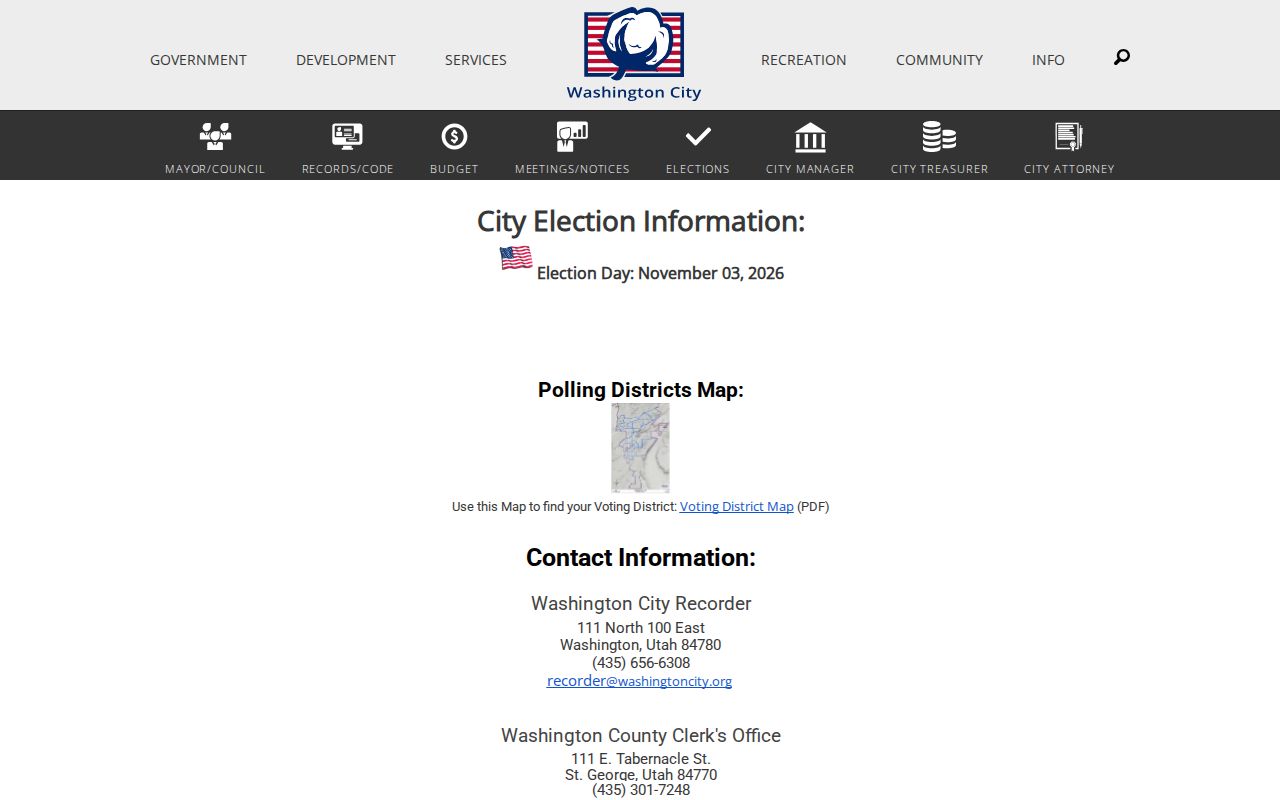
The city page is the sound starting point for candidate and municipal notices; registration status and voter-list fulfillment continue through state and county channels.
Order Washington County Voter Files
The Washington County Public Service Request asks for the requester name, organization or candidate or party, mailing details, email, phone, requested list and geography, a purpose narrative, signature, and date. County staff calculate the charge, call for payment, and deliver an encrypted XLSX file. A card payment adds 2.5 percent, with a $1.50 minimum.
- Choose the file and area. Identify whether the request is for Washington City, a precinct, county data, or another listed district.
- Complete the purpose and attestation. State the permitted political purpose, confirm qualification, and agree not to pass the file to an unqualified person.
- Send the signed form. Email it, mail it, or deliver it in person to Washington County Elections.
- Pay after calculation. Staff contact the requester with the total before sending the encrypted spreadsheet.
Under the county schedule adopted in August 2024, a class-3 county list such as Washington County costs $100, a class-3-or-smaller city list costs $50, a precinct costs $15, and local school board data costs $25. District prices vary. Unusual data is priced after review. The statewide database is a separate $1,050 purchase from the Lieutenant Governor, with no refund, subscription, or free update.
The state's voter-file and election-data order page documents the statewide file, reports, delivery, and privacy classes.
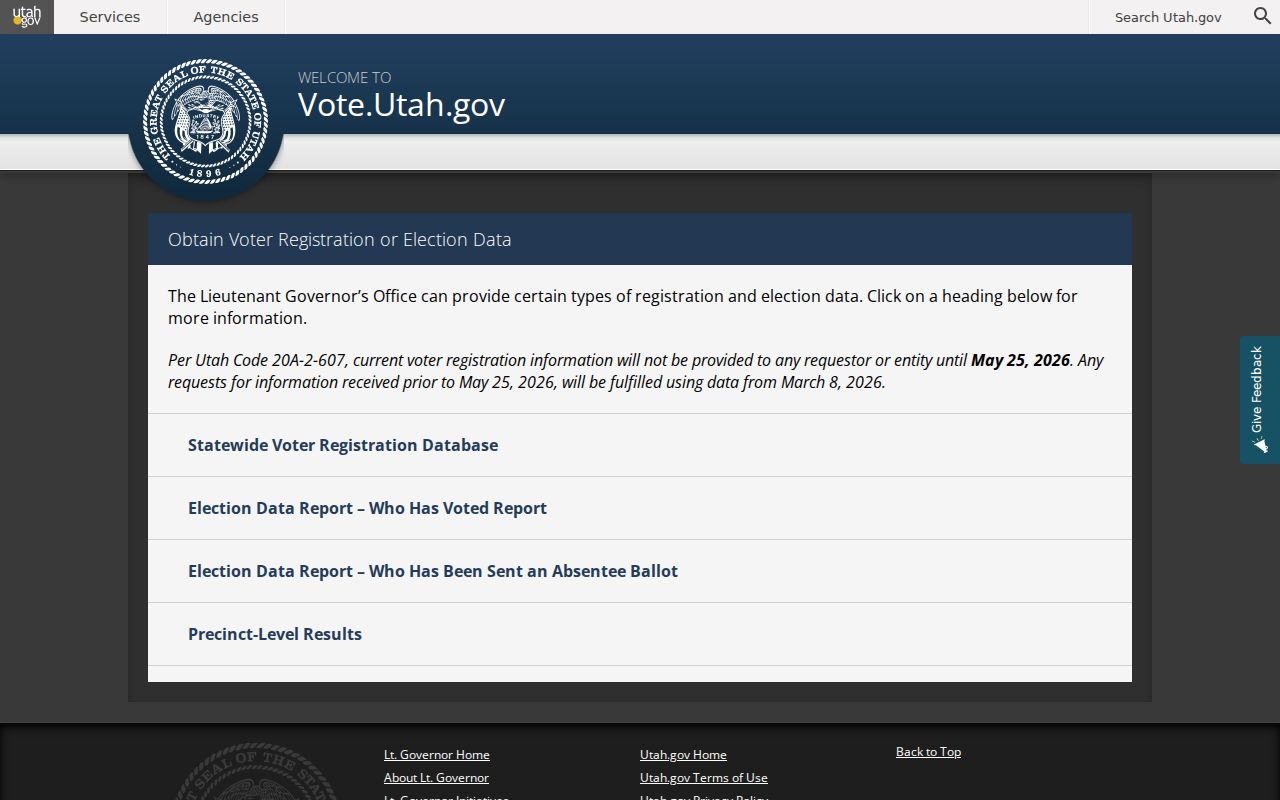
The statewide download is tab-delimited, about 150MB, and arrives through an emailed link within one business day. County data remains the more focused route for Washington-specific work.
Washington Voter Reports Protect Ballots
Election reports describe participation, not ballot choices. Regular even-year primary and general election Who Has Voted and sent-absentee reports cost $35 per election. They arrive daily from 21 days before Election Day through the day before it. Those products are unavailable for odd-year municipal elections and after an election. Precinct results requests are free.
A who-voted file can include voter ID, full legal name, complete residence, county, precinct or congressional district, voting method, processing date, and party. A sent-ballot file substitutes ballot-order and processing dates. At-risk identity remains suppressed in both. The line is firm: officials may report whether a ballot entered the process, but the secret vote itself does not become a voter-registration field.
Washington Inactive Voter Status
Inactive status is part of list maintenance, not a statement about a person's ballot choices. A voter who does not take part across the applicable federal cycle and does not update the record may become inactive and receive confirmation mail. Continued inactivity through another federal cycle can lead to removal under the National Voter Registration Act process.
Utah publishes monthly confirmation cards, returns, and removals. Current removal files begin in November 2025 and are kept online for two years. The statewide count on July 20, 2026, listed 1,778,184 active voters and 310,424 inactive voters, or 2,088,612 total. County and party downloads, plus annual files from 2014 through 2026, help place one Washington record in the wider maintenance cycle.
Washington Voter Privacy Changed
SB153 created a major transition in 2026. More than 300,000 Utah voters received privacy notices, and most registrations that had been private or withheld moved to public status on May 25. Requests made before that date relied on a March 8 snapshot. That timing matters when two lawful files show different visibility or status for the same registration.
Purchase is not publication permission. Utah Code §20A-2-607 prohibits knowingly posting voter-list information online, whether access is free or paid.
The signed county attestation invokes Utah Code §76-8-504 for false statements. False pretenses, prohibited transfer, or prohibited use can be a class A misdemeanor. Public availability also never permits threats, surveillance, or harassment. Utah's stalking law, §76-5-106.5, and electronic-communication harassment law, §76-12-202, can apply to misuse of personal data.
Historical Washington Voter Records
For research beyond the current voter roll, the Utah State Archives city and county records guide is the archival channel. Voter-registration records in Archives series 28818 are permanently retained. The official catalog sweep did not establish one exact year span for Washington County poll books or registers, so researchers should ask Archives staff to identify the series, creating office, and available dates before planning a visit or copy request.
Older election records may answer a different question from today's self-lookup. They can place a name in a past precinct, support civic or family history, or explain a registration move. Access depends on the series and any restrictions. Washington City, Washington County, and state election files should not be treated as one seamless database simply because they concern the same voter.